
David Bowie’s Private Collection Is Hiding in Downtown Mount Dora
David Bowie’s Private Collection Is Hiding in Downtown Mount Dora
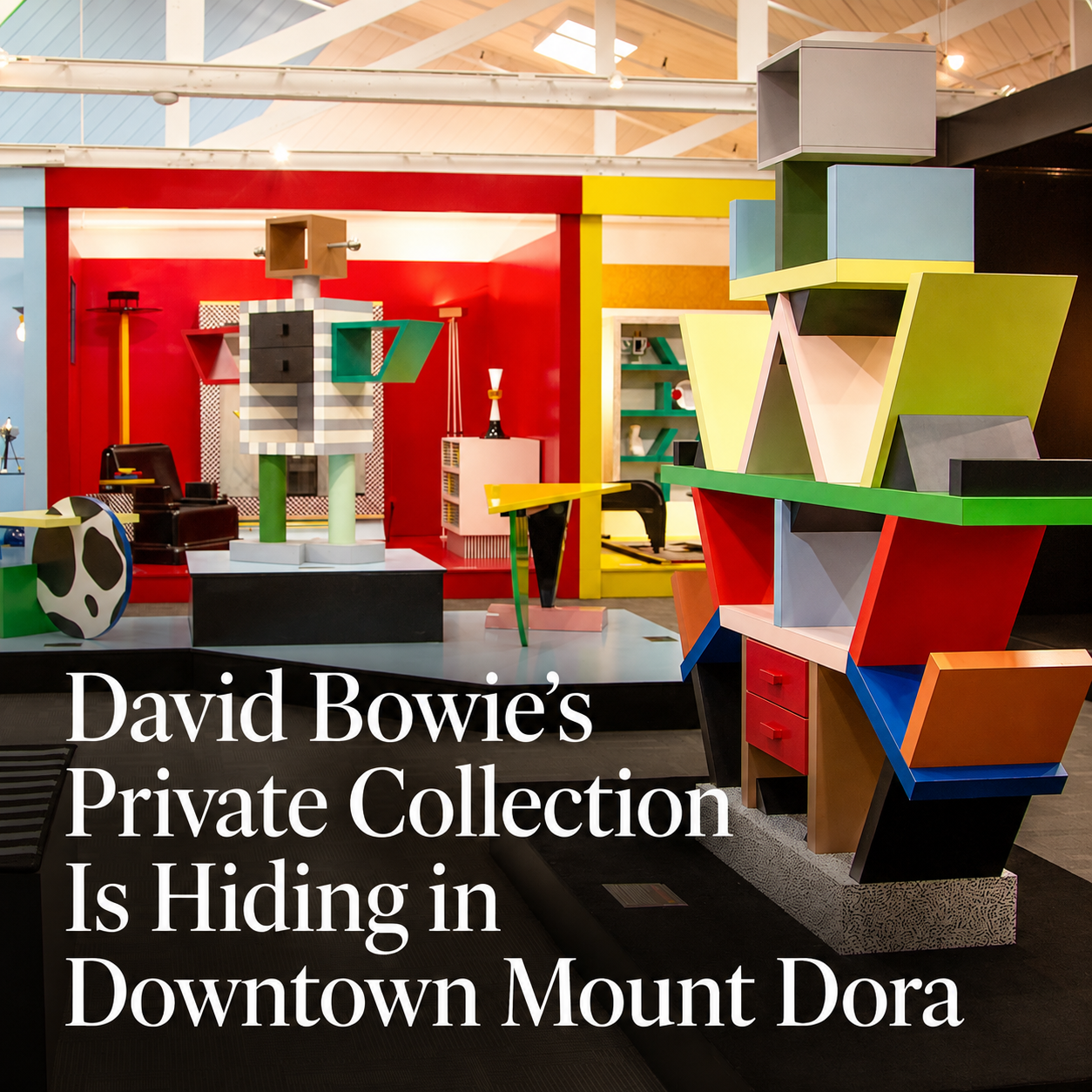
Step inside Modernism Museum Mount Dora, where more than 75 pieces of radical Memphis design — many from David Bowie’s private collection — create one of downtown’s most unexpected cultural experiences.

There are certain things you expect to find while wandering downtown Mount Dora.
Historic buildings. Antique shops. Art galleries. Restaurants tucked into courtyards. Lake views waiting at the end of the street.
David Bowie’s private collection probably is not one of them.
Yet walk through the doors of Modernism Museum Mount Dora on East Fourth Avenue and the scenery changes almost instantly.
Bright colors collide. Furniture takes on strange geometric shapes. Lamps look more like sculpture. Shelving becomes architecture. Objects that were technically designed to be useful seem just as interested in making you stop and stare.
Then you begin noticing the names attached to them.
Ettore Sottsass. Michele De Lucchi. Peter Shire. Nathalie DuPasquier. And, appearing again and again in the history behind the collection, David Bowie.
The museum’s current exhibition, Space Oddities: The Sequel, brings together more than 75 examples of Memphis design, many from Bowie’s private collection. According to the museum, it is the largest gathering of Memphis objects ever presented in an American museum.
And somehow, you can find it without leaving downtown Mount Dora.
First, What Exactly Is Memphis?

You do not need to know anything about design before walking inside.
In some ways, that might make the experience more fun.
Memphis emerged in Milan in the early 1980s around Italian architect and designer Ettore Sottsass, with a group of designers who were considerably less interested in making furniture quietly blend into a room.
Instead came bold colors, exaggerated shapes, graphic patterns, unexpected materials and objects that challenged the usual line between functional furniture and art. The movement helped define one of the most recognizable visual languages of the 1980s.
Inside Modernism Museum, you get to see that philosophy repeated dozens of different ways.
Some pieces immediately make sense as furniture. Others require a second look.
A cabinet might jut outward in different directions. A lamp might look like something dreamed up for a cartoon version of the future. Plastic laminate — the sort of material rarely associated with precious museum objects — suddenly becomes part of the point.
There are pieces you may desperately want in your house and others you may spend several minutes trying to imagine in anyone’s house.
Both reactions are valid.
The fun is in looking.
Then David Bowie Enters the Story

At some point during the visit, another detail changes the way you see the collection.
Many of these objects once belonged to David Bowie.
Bowie became a significant collector of Memphis design, and pieces from his collection eventually entered the exhibition now displayed in Mount Dora. The museum describes Space Oddities: The Sequel as a chance to experience both Memphis in abundance and a glimpse into the private world of one of pop culture’s great creative figures.
The connection starts to make sense the longer you walk around.
Bowie built a career around reinvention. He moved between characters, sounds, fashion and visual identities without much interest in staying inside one category.
Memphis designers were challenging conventions in their own way.
They were taking familiar objects — chairs, lamps, cabinets and tables — and asking why those things needed to look the way people expected them to look.
Knowing Bowie chose to surround himself with some of these pieces adds another layer to the visit.
You are no longer simply looking at an influential chapter in design history. You are also seeing objects that caught the attention of someone whose own creative life was built around experimentation.
Do Not Rush the Weird Stuff

This is not a museum that requires hours of preparation or a degree in design history.
Walk in and look for the things that make you stop.
Notice the colors first.
Then the shapes.
Move closer and look at the materials. Step back and see how several pieces interact with one another. Read about the designers behind the objects that seem particularly strange, beautiful or impossible to ignore.
One of the most recognizable Sottsass pieces represented by the museum, for example, is the Casablanca cabinet, with shelves projecting outward from a central form and colorful plastic laminates that turn an ordinary storage object into something far more theatrical.
Seeing an individual Memphis object is interesting.
Seeing more than 75 of them together is something else entirely.
The repetition begins to reveal that all the strange colors, angles and materials were not simply 1980s eccentricity. They were part of a deliberate attempt to rethink what everyday objects could be.
And decades later, much of it still looks surprisingly futuristic.
Then Cross Fourth Avenue
Eventually, you step back outside.
Fourth Avenue looks normal again.
Before moving on, cross the street.
The Modernism Museum Shoppe sits directly opposite the museum at 144 E. Fourth Avenue and feels like a natural continuation of the experience rather than an obligatory souvenir stop.
The Shoppe carries art and design books, jewelry, apparel, art glass, home accessories, gifts and exhibition-inspired pieces, all curated around the same modernist sensibility visitors have just encountered inside the galleries.
Even if you do not plan on buying anything, it is worth wandering through.
After an hour spent thinking about why objects look the way they do, you may find yourself paying considerably more attention to them.
One More Reason to Keep Exploring Downtown
Part of Mount Dora’s appeal is that the city rarely reveals everything at once.
A narrow lane turns into an outdoor art gallery. An old storefront opens into a restaurant. An antique booth contains something that has already lived several lives.
And on Fourth Avenue, one door opens onto radical Italian design and objects that once occupied David Bowie’s private world.
Modernism Museum does not necessarily fit the version of Mount Dora someone might picture before arriving.
That is exactly why it belongs on the itinerary.
Sometimes the most memorable part of exploring a familiar-looking place is finding the thing you never expected to be there.
And this one is hiding in plain sight.
Plan Your Visit
Modernism Museum Mount Dora is located at 145 E. Fourth Avenue in downtown Mount Dora. The museum is currently open Thursday through Sunday from 11 a.m. to 5 p.m. and is closed on major holidays. Admission is currently $8 for adults, $7 for seniors and students with ID, and $5 for children ages 4–17. Mount Dora residents, military members and service personnel receive 50 percent off admission with ID.
The Modernism Museum Shoppe is directly across the street at 144 E. Fourth Avenue and is currently open seven days a week.
Hours, admission and exhibitions can change, so check current details with the museum before your visit.
Meet Me in Mount Dora is a recurring visitor series featuring memorable ways to eat, explore and experience the city.

